

poems …
Pygmalion by Vanessa StaufferB
Pygmalion’s Bride by Carol Ann Duffy
our poems HERE …
none yet

@@@@@
the story in short –
Orpheus, having lost Eurydice at their wedding, now amuses himself and his audience of trees by telling a number of steamy stories. Mostly romantic ones about boys … dead Cyparissus turned into a cypress tree, dead Hyacinthus turned into a flower and Ganymede, not turned into anything but abducted by Jupiter … but all the more disturbing stories about girls seem to be here too
Here is the story of Pygmalion and Galatea, although the name Galatea came from a later writer as Orpheus does not name her at all
Pygmalion, a sculptor living on the island of Cyprus is so horrified by the story of the prostitutes that painted themselves and turned into stones (in Orpheus’ previous story) that he abjures the company of women entirely, staying only in his studio, working and carving the statue of a woman out of ivory

Unfortunately he is just TOO talented and, what with the social isolation and long hours at work, he falls in love with the statue, hallucinating that it is made out of flesh
He talks to it, kisses it, brings it little gifts and worries that he might be bruising it. He dresses it up in clothes and then, surprise surprise, undresses it again and puts it in his bed.
Bye and bye there is a festival of Venus in the town as Cypress is, after all, her sacred island and having made the appropriate prayers and sacrifices of heifers, Pygmalion gets to talk directly to the goddess and make a wish. Too shy to tell her what he Really wants, he asks for a girl just LIKE the ivory one he had left back at home propped up on his pillow.
Venus, being a goddess and in a good mood, knows exactly what he really wants and when he gets home he finds that the girl he carved out of ivory is now made out of flesh.
Venus herself attended their wedding but she wasn’t going far out of her way to do that as she lived locally.
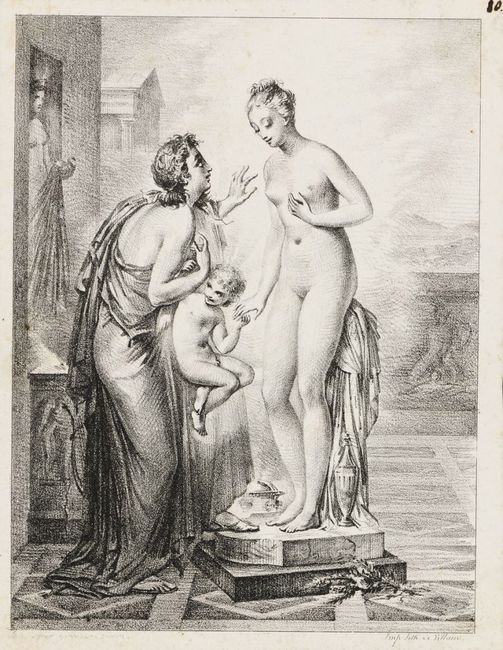
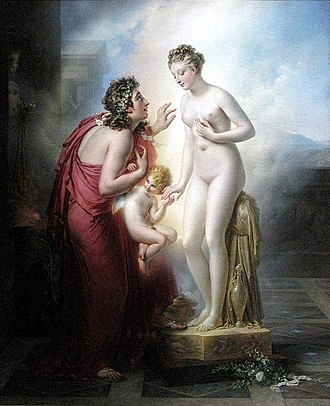
And were they happy? Who knows
As likely as any other couple, I would say, so long as she didn’t get any independent ideas and he didn’t fall for any other of his statues. At any rate, nine months after the wedding, Galatea gave birth to a son whom they named Paphos and after whom the town of Paphos is named.
Which is odd because Pygmalion is said to have come from Paphos in the first place
Note:-
This story has been the dubious inspiration of numberless paintings and also the play Pygmalion by George Bernard Shaw in which a flower girl, having been 'improved' beyond recognition by Professor Higgins, leaves him and opens a florists shop

BACK – Orpheus and Eurydice  NEXT-
NEXT-
@@@@@@@
Bk X:243-297 Orpheus sings: Pygmalion and the statue
‘Pygmalion had seen them, spending their lives in wickedness, and, offended by the failings that nature gave the female heart, he lived as a bachelor, without a wife or partner for his bed. But, with wonderful skill, he carved a figure, brilliantly, out of snow-white ivory, no mortal woman, and fell in love with his own creation. The features are those of a real girl, who, you might think, lived, and wished to move, if modesty did not forbid it. Indeed, art hides his art. He marvels: and passion, for this bodily image, consumes his heart. Often, he runs his hands over the work, tempted as to whether it is flesh or ivory, not admitting it to be ivory. He kisses it and thinks his kisses are returned; and speaks to it; and holds it, and imagines that his fingers press into the limbs, and is afraid lest bruises appear from the pressure. Now he addresses it with compliments, now brings it gifts that please girls, shells and polished pebbles, little birds, and many-coloured flowers, lilies and tinted beads, and the Heliades’s amber tears, that drip from the trees. He dresses the body, also, in clothing; places rings on the fingers; places a long necklace round its neck; pearls hang from the ears, and cinctures round the breasts. All are fitting: but it appears no less lovely, naked. He arranges the statue on a bed on which cloths dyed with Tyrian murex are spread, and calls it his bedfellow, and rests its neck against soft down, as if it could feel.
The day of Venus’s festival came, celebrated throughout Cyprus, and heifers, their curved horns gilded, fell, to the blow on their snowy neck. The incense was smoking, when Pygmalion, having made his offering, stood by the altar, and said, shyly: “If you can grant all things, you gods, I wish as a bride to have…” and not daring to say “the girl of ivory” he said “one like my ivory girl.” Golden Venus, for she herself was present at the festival, knew what the prayer meant, and as a sign of the gods’ fondness for him, the flame flared three times, and shook its crown in the air. When he returned, he sought out the image of his girl, and leaning over the couch, kissed her. She felt warm: he pressed his lips to her again, and also touched her breast with his hand. The ivory yielded to his touch, and lost its hardness, altering under his fingers, as the bees’ wax of Hymettus softens in the sun, and is moulded, under the thumb, into many forms, made usable by use. The lover is stupefied, and joyful, but uncertain, and afraid he is wrong, reaffirms the fulfilment of his wishes, with his hand, again, and again.
It was flesh! The pulse throbbed under his thumb. Then the hero, of Paphos, was indeed overfull of words with which to thank Venus, and still pressed his mouth against a mouth that was not merely a likeness. The girl felt the kisses he gave, blushed, and, raising her bashful eyes to the light, saw both her lover and the sky. The goddess attended the marriage that she had brought about, and when the moon’s horns had nine times met at the full, the woman bore a son, Paphos, from whom the island takes its name.’
<<<<<<<<<<<<<<<<<<<<<<<<<<<<<<
<<<<<<<<<<<<<<<<<<<<<<<<<<<<<<
 thingstothings