

our poems …

@@@@@@@@@@@


story in short –
…
Bacchus, having turned some of the Maenads into trees after their murder of Orpheus back in Thrace, must have crossed the Hellespont and is returning to the vineyards of his own Mount Tmolos, in Lydia with his rather reduced band of followers.

Not just reduced by not having the maenads but reduced by his old tutor, Silenus, who had somehow gone missing on the journey
But all was well with the old chap as the peasants had found him, fat, naked and drunkenly stumbling around Phrygia. They had captured him with garlands of flowers and taken him to their king.
Midas, king of Phrygia and another initiate of the Bacchic rites (as taught by Orpheus himself on his Asia tour) had instantly recognised another party animal and feasted with him for ten days before having him carried to Lydia to reunite him with his foster-child and their gang of satyrs, cupids, maenads and other inebriates.
Bacchus was so delighted with the return of the old soak (and foster-father) that he let Midas chose a gift. Even knowing as he said the words that Midas would make a stupid choice.
“Make it so that everything I touch turns to yellow gold” said Midas. And Bacchus sighed and gave him the gift.


 NEXT-
NEXT- @@@@@@@
Midas
The king of Phrygia, son of Gordius and Cybele, called Berecyntius heros from Mount Berecyntus in Phrygia, sacred to Cybele.
Bk XI:85-145. In reward for returning Silenus to him, Bacchus grants Midas a gift. He chooses the golden touch, and when it plagues him Bacchus takes it away again. He is instructed to bathe in the waters of the Pactolus to cleanse himself. (Lines 131-141 suggest that Ovid was aware of early confession and baptism rites, from Christianity or some other religion, or, less likely, that there has been rewriting by a later Christian scribe)
Bk XI:146-171. Bk XI:172-193. Phoebus gives him the ears of an ass, and a servant gives away the secret
>>>>>>>>>>>>>>>>>>>>>>>>>>….
Bk XI:85-145 Midas and the golden touch
This did not satisfy Bacchus. He left the fields themselves, and with a worthier band of followers sought out the vineyards of his own Mount Tmolus, and the River Pactolus, though at that time it was not a golden stream, nor envied for its valuable sands. His familiar cohorts, the satyrs and bacchantes accompanied him, but Silenus was absent. The Phrygian countrymen had taken him captive, stumbling with age and wine, bound him with garlands, and led him to King Midas, to whom, with Athenian Eumolpus, Orpheus of Thrace had taught the Bacchic rites.
When the king recognised him as a friend and companion of his worship, he joyfully led a celebration of the guest’s arrival, lasting ten days and nights on end. And now, on the eleventh day, Lucifer had seen off the train of distant stars, and the king with gladness came to the fields of Lydia, and restored Silenus to his young foster-child.
Then the god, happy at his foster-father’s return, gave Midas control over the choice of a gift, which was pleasing, but futile, since he was doomed to make poor use of his reward. ‘Make it so that whatever I touch with my body, turns to yellow gold,’ he said. Bacchus accepted his choice, and gave him the harmful gift, sad that he had not asked for anything better. The Berecyntian king departed happily, rejoicing in his bane, and testing his faith in its powers by touching things, and scarcely believing it when he broke off a green twig from the low foliage of the holm-oak: the twig was turned to gold. He picked up a stone from the ground: the stone also was pale gold. He touched a clod of earth, and by the power of touch, the clod became a nugget. He gathered the dry husks of corn: it was a golden harvest. He held an apple he had picked from a tree: you would think the Hesperides had given it to him. If he placed his fingers on the tall door-pillars, the pillars were seen to shine. When he washed his hands in clear water, the water flowing over his hands would have deceived Danaë.
His own mind could scarcely contain his expectations, dreaming of all things golden. As he was exulting, his servants set a table before him, heaped with cooked food, and loaves were not lacking. Then, indeed, if he touched the gift of Ceres with his hand, her gift hardened. If he tried, with eager bites, to tear the food, the food was covered with a yellow surface where his teeth touched. He mixed pure water with wine, the other gift of his benefactor, but molten gold could be seen trickling through his lips.
Dismayed by this strange misfortune, rich and unhappy, he tries to flee his riches, and hates what he wished for a moment ago. No abundance can relieve his famine: his throat is parched with burning thirst, and, justly, he is tortured by the hateful gold. Lifting his shining hands and arms to heaven, he cries out: ‘Father, Bacchus, forgive me! I have sinned. But have pity on me, I beg you, and save me from this costly evil!’ The will of the gods is kindly. Bacchus, when he confessed his fault, restored him, and took back what he had given in fulfilment of his promise. ‘So you do not remain coated with the gold you wished for so foolishly,’ he said, ‘go to the river by great Sardis, make your way up the bright ridge against the falling waters, till you come to the source of the stream, and plunge your head and body at the same moment into the foaming fountain, where it gushes out, and at the same time wash away your sin.’ The king went to the river as he was ordered: the golden virtue coloured the waters, and passed from his human body into the stream. Even now, gathering the grains of gold from the ancient vein, the fields harden, their soil soaked by the pale yellow waters.
Bk XI:146-171 Pan and Apollo compete before Tmolus
Hating wealth, Midas lived among woods and fields, and the mountain caves Pan always inhabits. But he remained dull-witted, and, as before, his foolish mind was destined once again to hurt its owner. Mount Tmolus, stands steep and high, commanding a wide view of the distant sea, its sloping sides extending to Sardis on the one side, and as far as tiny Hypaepae on the other. While Pan was there, playing light airs on his reeds glued together with wax, he boasted of his pipings, to the gentle nymphs, and dared to speak slightingly of Apollo’s song compared with his own, and entered an unequal contest with Tmolus, the god of the mountain, as judge.
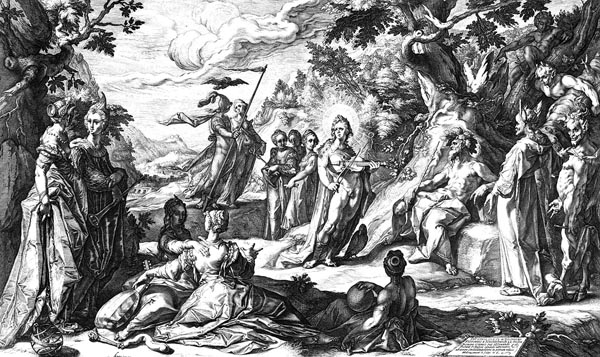
The aged judge was seated on his mountain-top and shook his ears free of the trees. Only an oak-wreath circled his dark hair, and acorns brushed against his hollow temples. Looking at the god of the flocks he said: ‘There is nothing to prevent my judging.’ Pan sounded the rustic reeds, and entranced Midas (who chanced to be near the playing) with wild pipings. Following this, sacred Tmolus turned his face towards that of Phoebus: his forests followed.
Phoebus’s golden hair was wreathed with laurel from Parnassus, and his robes dyed with Tyrian purple, swept the earth. He held his lyre, inlaid with gems and Indian ivory, in his left hand, and the plectrum in the other. His attitude was that of a true artist. Then with skilled fingers, he plucked the strings, and Tmolus, captivated by their sweetness, ordered Pan to lower his pipes in submission to the lyre.
Bk XI:172-193 Midas and the ass’s ears
The judgement of the sacred mountain-god satisfied all opinions, and yet Midas’s voice alone challenged it and called it unjust. The god of Delos did not allow such undiscriminating ears to keep their human form, but drew them out and covered them with shaggy grey hair, and made them flexible at the base, and gave them powers of movement. Though the rest was human, he was punished in that sole aspect: he wore the ears of a slow-moving ass. He was anxious to conceal them, and tried to detract from the shameful ugliness of his head with a purple turban. But the servant who used to trim his long hair with a blade, found it out, who, since he dare not reveal the disgrace he had seen, but eager to broadcast it to the four winds, and unable to keep it to himself, went off quietly and dug a hole in the soil. In a tiny voice, he whispered to the hollow earth, and buried his spoken evidence under the infill, and stole away having closed up the hidden trench. But a thick bed of quivering reeds began to shoot up there, and as soon as they had grown, at the end of the year, they gave the burrower away: stirred gently, then, by the wind they repeated the buried words, and testified against his master.
Bk XI:194-220 Laomedon and the walls of Troy
Having punished him, Latona’s son left Mount Tmolus and, flying through the clear air, he came to earth in the country of Laomedon, this side of the narrows of the Hellespont, named from Helle, daughter of Nephele. To the right of the deeps of Sigeum, and to the left of those of Rhoeteum, there was an ancient altar of Jupiter the Thunderer, ‘source of all oracles’. There, Apollo saw Laomedon building the foundations of the new city of Troy. The great undertaking prospering with difficulty, and demanding no little resources, he, and Neptune, trident-bearing father of the swelling sea, put on mortal form, and built the walls of the city for the Phrygian king for an agreed amount in gold. The edifice stood there.
But the king denied them payment, and as a crowning treachery, perjured himself by claiming they were lying. The ruler of the ocean said: ‘You will not go unpunished’, and he turned all his waters against the shores of tight-fisted Troy. He flooded the land to form a strait, swept away the farmers’ crops, and buried the fields beneath the waves. Even this was insufficient punishment: He demanded also that Hesione, the king’s daughter, be given to a sea-monster, whom Hercules freed, as she was chained to the solid rock. Hercules demanded the payment promised, an agreed number of horses. But the reward for all his work being refused, he seized the twice-perjured walls of conquered Troy. Telamon, his companion, did not go without honour, and Hesione was given to him in marriage.
Peleus, Telamon’s brother, was already distinguished by having a goddess as his wife, and was not more proud of being Jupiter’s grandson (his father Aeacus being the son of Jove by Aegina) as his son-in-law (by marrying Thetis), since he was not the only brother to be Jove’s grandson, but he was the only one to marry a goddess.
https://www.poetryintranslation.com/PITBR/Latin/Metamorph11.php#Bkeleven85
<<<<<<<<<<<<<<<<<<<<<<<<<<<<<<
<<<<<<<<<<<<<<<<<<<<<<<<<<<<<<
 thingstothings