

poems …
our poems HERE …

@@@@@@
the story in short –
In short … the gods and especially Jupiter was just furious at the behaviour of humans and decided to destroy the world. But not by fire which might endanger their home in Heaven too – but by incessant rain and floods. He enlisted the help of his brother the sea god and also the rivers in creating this totally catastrophic wash out and soon all Living things which were not swept away in the torrents perished from lack of food in the devastated land. Everyone and everything was destroyed except two people in a boat and these were Decalion and his wife Pyrrha – both massively godfearing and pious – and the boat washes up on the peak of Mount Parnassus .
So they go to the temple of Themis, goddess of oracles, which just happens to be conveniently at hand . By now, due to the floods, it has no fires and is covered with slime and moss but they ask anyway what they should do
Themis answers ‘Leave the temple and with veiled heads and loosened clothes throw behind you the bones of your great mother!’
Which obviously they think is quite mad. Pyrrha downright refuses to do any such thing with the bones of her mother – even if she happened to have them at hand which she didn’t … but after some hard thinking, Deucalion guesses that ” the great mother ” might refer to the earth herself and in which case her “bones ” might mean stones … so … while not at all sure that they have got this right but with really nothing to lose, they do as Themis suggests and wrap themselves in veils and loose clothes and walk along throwing stones onto the ground behind them.
The stones become soft around the edges and then become flesh. Those that Deucalion throws become men and those that Pyrrha throws become women and in that way they repopulate the land with better people than before and it also explains why all the people of Greece are so tough – it is because they are descended from stones.
And then also all other life forms began to spontaneously regenerate from the mud and the debris as we know does happen – for instance – in Egypt after the Nile floods recede. Some were similar to the ones that existed before the flood and some were entirely new forms of Life and this is exactly how we came to have the world we have today.


BACK – Lycaon  NEXT- …..
@@@@@@@

Bk I:244-273 Jupiter invokes the floodwaters
When he had spoken, some of the gods encouraged Jupiter’s anger, shouting their approval of his words, while others consented silently. They were all saddened though at this destruction of the human species, and questioned what the future of the world would be free of humanity. Who would honour their altars with incense? Did he mean to surrender the world to the ravages of wild creatures? In answer the king of the gods calmed their anxiety, the rest would be his concern, and he promised them a people different from the first, of a marvellous creation.
Now he was ready to hurl his lightning-bolts at the whole world but feared that the sacred heavens might burst into flame from the fires below, and burn to the furthest pole: and he remembered that a time was fated to come when sea and land, and the untouched courts of the skies would ignite, and the troubled mass of the world be besieged by fire. So he set aside the weapons the Cyclopes forged, and resolved on a different punishment, to send down rain from the whole sky and drown humanity beneath the waves.
Straight away he shut up the north winds in Aeolus’s caves, with the gales that disperse the gathering clouds, and let loose the south wind, he who flies with dripping wings, his terrible aspect shrouded in pitch-black darkness. His beard is heavy with rain, water streams from his grey hair, mists wreathe his forehead, and his feathers and the folds of his robes distil the dew. When he crushes the hanging clouds in his outstretched hand there is a crash, and the dense vapours pour down rain from heaven. Iris, Juno’s messenger, dressed in the colours of the rainbow, gathers water and feeds it back to the clouds. The cornfields are flattened and saddening the farmers, the crops, the object of their prayers, are ruined, and the long year’s labour wasted.
Bk I:274-292 The Flood
Jupiter’s anger is not satisfied with only his own aerial waters: his brother the sea-god helps him, with the ocean waves. He calls the rivers to council, and when they have entered their ruler’s house, says ‘Now is not the time for long speeches! Exert all your strength. That is what is needed. Throw open your doors, drain the dams, and loose the reins of all your streams!’ Those are his commands. The rivers return and uncurb their fountains’ mouths, and race an unbridled course to the sea.
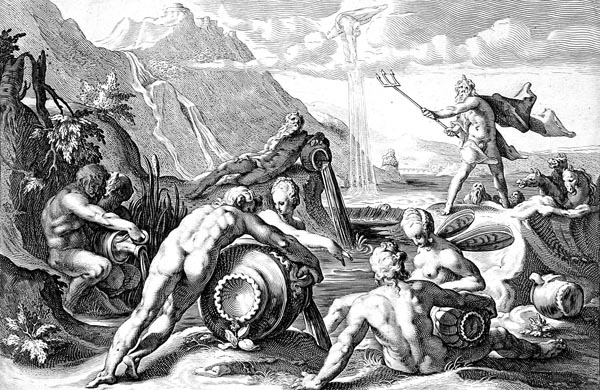
Neptune himself strikes the ground with his trident, so that it trembles, and with that blow opens up channels for the waters. Overflowing, the rivers rush across the open plains, sweeping away at the same time not just orchards, flocks, houses and human beings, but sacred temples and their contents. Any building that has stood firm, surviving the great disaster undamaged, still has its roof drowned by the highest waves, and its towers buried below the flood. And now the land and sea are not distinct, all is the sea, the sea without a shore.
Bk I:293-312 The world is drowned
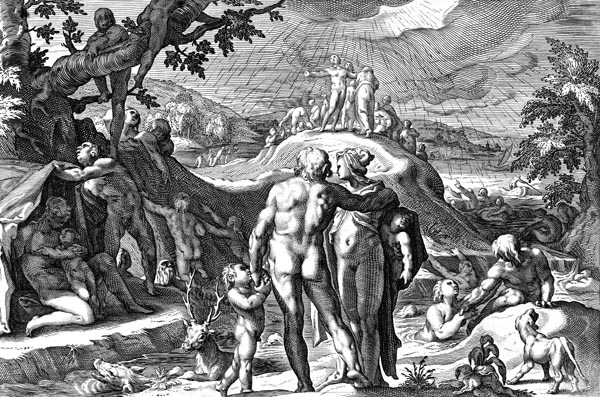
There one man escapes to a hilltop, while another seated in his rowing boat pulls the oars over places where lately he was ploughing. One man sails over his cornfields or over the roof of his drowned farmhouse, while another man fishes in the topmost branches of an elm. Sometimes, by chance, an anchor embeds itself in a green meadow, or the curved boats graze the tops of vineyards. Where lately lean goats browsed shapeless seals play. The Nereids are astonished to see woodlands, houses and whole towns under the water. There are dolphins in the trees: disturbing the upper branches and stirring the oak-trees as they brush against them. Wolves swim among the sheep, and the waves carry tigers and tawny lions. The boar has no use for his powerful tusks, the deer for its quick legs, both are swept away together, and the circling bird, after a long search for a place to land, falls on tired wings into the water. The sea in unchecked freedom has buried the hills, and fresh waves beat against the mountaintops. The waters wash away most living things, and those the sea spares, lacking food, are defeated by slow starvation.
Bk I:313-347 Deucalion and his wife Pyrrha
Phocis, a fertile country when it was still land, separates Aonia from Oeta, though at that time it was part of the sea, a wide expanse of suddenly created water. There Mount Parnassus lifts its twin steep summits to the stars, its peaks above the clouds. When Deucalion and his wife landed here in their small boat, everywhere else being drowned by the waters, they worshipped the Corycian nymphs, the mountain gods, and the goddess of the oracles, prophetic Themis.
No one was more virtuous or fonder of justice than he was, and no woman showed greater reverence for the gods. When Jupiter saw the earth covered with the clear waters, and that only one man was left of all those thousands of men, only one woman left of all those thousands of women, both innocent and both worshippers of the gods, he scattered the clouds and mist, with the north wind, and revealed the heavens to the earth and the earth to the sky. It was no longer an angry sea, since the king of the oceans putting aside his three-pronged spear calmed the waves, and called sea-dark Triton, showing from the depths his shoulders thick with shells, to blow into his echoing conch and give the rivers and streams the signal to return. He lifted the hollow shell that coils from its base in broad spirals, that shell that filled with his breath in mid-ocean makes the eastern and the western shores sound. So now when it touched the god’s mouth, and dripping beard, and sounded out the order for retreat, it was heard by all the waters on earth and in the ocean, and all the waters hearing it were checked. Now the sea has shorelines, the brimming rivers keep to their channels, the floods subside, and hills appear. Earth rises, the soil increasing as the water ebbs, and finally the trees show their naked tops, the slime still clinging to their leaves.
Bk I:348-380 They ask Themis for help
The world was restored. But when Deucalion saw its emptiness, and the deep silence of the desolate lands, he spoke to Pyrrha, through welling tears. ‘Wife, cousin, sole surviving woman, joined to me by our shared race, our family origins, then by the marriage bed, and now joined to me in danger, we two are the people of all the countries seen by the setting and the rising sun, the sea took all the rest. Even now our lives are not guaranteed with certainty: the storm clouds still terrify my mind. How would you feel now, poor soul, if the fates had willed you to be saved, but not me? How could you endure your fear alone? Who would comfort your tears? Believe me, dear wife, if the sea had you, I would follow you, and the sea would have me too. If only I, by my father’s arts, could recreate earth’s peoples, and breathe life into the shaping clay! The human race remains in us. The gods willed it that we are the only examples of mankind left behind.’ He spoke and they wept, resolving to appeal to the sky-god, and ask his help by sacred oracles. Immediately they went side by side to the springs of Cephisus that, though still unclear, flowed in its usual course. When they had sprinkled their heads and clothing with its watery libations, they traced their steps to the temple of the sacred goddess, whose pediments were green with disfiguring moss, her altars without fire. When they reached the steps of the sanctuary they fell forward together and lay prone on the ground, and kissing the cold rock with trembling lips, said ‘If the gods’ wills soften, appeased by the prayers of the just, if in this way their anger can be deflected, Themis tell us by what art the damage to our race can be repaired, and bring help, most gentle one, to this drowned world!’
Bk I:381-415 The human race is re-created
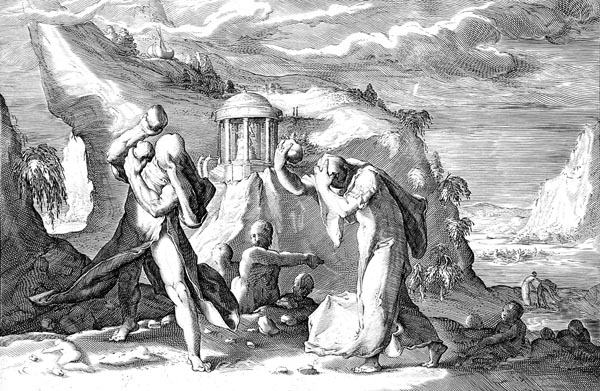
The goddess was moved, and uttered oracular speech: ‘Leave the temple and with veiled heads and loosened clothes throw behind you the bones of your great mother!’ For a long time they stand there, dumbfounded. Pyrrha is first to break the silence: she refuses to obey the goddess’s command. Her lips trembling she asks for pardon, fearing to offend her mother’s spirit by scattering her bones. Meanwhile they reconsider the dark words the oracle gave, and their uncertain meaning, turning them over and over in their minds. Then Prometheus’s son comforted Epimetheus’s daughter with quiet words: ‘Either this idea is wrong, or, since oracles are godly and never urge evil, our great mother must be the earth: I think the bones she spoke about are stones in the body of the earth. It is these we are told to throw behind us.’
Though the Titan’s daughter is stirred by her husband’s thoughts, still hope is uncertain: they are both so unsure of the divine promptings; but what harm can it do to try? They descended the steps, covered their heads and loosened their clothes, and threw the stones needed behind them. The stones, and who would believe it if it were not for ancient tradition, began to lose their rigidity and hardness, and after a while softened, and once softened acquired new form. Then after growing, and ripening in nature, a certain likeness to a human shape could be vaguely seen, like marble statues at first inexact and roughly carved. The earthy part, however, wet with moisture, turned to flesh; what was solid and inflexible mutated to bone; the veins stayed veins; and quickly, through the power of the gods, stones the man threw took on the shapes of men, and women were remade from those thrown by the woman. So the toughness of our race, our ability to endure hard labour, and the proof we give of the source from which we are sprung.
Bk I:416-437 Other species are generated
Earth spontaneously created other diverse forms of animal life. After the remaining moisture had warmed in the sun’s fire, the wet mud of the marshlands swelled with heat, and the fertile seeds of things, nourished by life-giving soil as if in a mother’s womb, grew, and in time acquired a nature. So, when the seven-mouthed Nile retreats from the drowned fields and returns to its former bed, and the fresh mud boils in the sun, farmers find many creatures as they turn the lumps of earth. Amongst them they see some just spawned, on the edge of life, some with incomplete bodies and number of limbs, and often in the same matter one part is alive and the other is raw earth. In fact when heat and moisture are mixed they conceive, and from these two things the whole of life originates. And though fire and water fight each other, heat and moisture create everything, and this discordant union is suitable for growth. So when the earth muddied from the recent flood glowed again heated by the deep heaven-sent light of the sun she produced innumerable species, partly remaking previous forms, partly creating new monsters.
https://www.poetryintranslation.com/PITBR/Latin/Metamorph.php#anchor_Toc64105462
<<<<<<<<<<<<<<<<<<<<<<<<<<<<<<
<<<<<<<<<<<<<<<<<<<<<<<<<<<<<<

 thingstothings