

poems
the sunflower – Leigh Gordon Giltner
sunflower child – Renn Flight
–
mushrooms – Sylvia Plath

our poems HERE –
@@@@@@@
the story in short – ……….
This story, like that of Pyramus and Thisbe, is one of the stories told by the daughters of Minyas as they are weaving before being turned into bats and it starts with the revenge of Venus on Apollo for her being caught in a net with her lover, Mars, in broad daylight and being embarrased in front of all the other gods who could see clearly what they were up to.
So, out of spite, Venus makes the Sun forget all his other lovers and fixate on Leucothoë, a beautiful Persian girl whose name means “the White Goddess”, and this is wrong because – being the sun – he should really be shining his glorious light upon absolutely everyone.
While his horses are resting in the West and grazing on the fields of ambrosia to build up strength for the next day’s journey across the sky, the besotted Sun sneaks into Leucothoë’s room where she is spinning threads and, pretending to be her mother which is weird even for Ovid, he seduces her … although she doesnt have much choice.
This infuriates Clytie, one of the lovers the Sun has passed over in his new passion, and out of jealousy she tells Leucothoë’s father what has been going on in Leucothoë’s room.
The father naturally blames Leucothoë herself and buries her alive in the deep earth and – even as she reaches out her arm to the sun – he tips a load of sand and gravel on her head .

The Sun is heartbroken and tries to reach down to her and revive her –
but sadly Leucothoë is dead, totally crushed by the weight of earth.
The sun god does not return to Clytie who he has lost interest in anyway but still she cannot take her eyes off him in his golden chariot as he crosses the sky.
She wastes away for love and obsession, her legs become roots and fastened into the ground and finally she becomes a plant.
The text seems to translate as a heliotrope but Clytie is often portrayed as a sunflower which turns with the sun . A.G.

CLYTIE THE HELIOTROPE
Ovid, Metamorphoses 4. 256 ff (trans. Melville) (Roman epic C1st B.C. to C1st A.D.) :
“Clytie loved Sol (the Sun) [Helios] beyond all measure . . . [but] the Lord of Light no longer visited; his dalliance was done. She pined and languished, as love and longing stole her wits away. Shunning the Nymphae (Nymphs), beneath the open sky, on the bare ground bare-headed day and night, she sat dishevelled, and for nine long days, with never taste of food or drink, she fed her hunger on her tears and on the dew. There on the ground she stayed; she only gazed upon her god’s bright face as he rode by, and turned her head to watch him cross the sky. Her limbs, they say, stuck fast there in the soil; a greenish pallor spread, as part of her changed to a bloodless plant, another part was ruby red, and where her face had been a flower like a violet [i.e. a heliotrope] was seen. Though rooted fast, towards the sun she turns; her shape is changed, but still her passion burns.”
https://www.theoi.com/Nymphe/Nymphai4Myths.html
@@@@@@@
Bk IV:190-213 Leuconoë’s story: Venus’s revenge
‘But Cytherea, remembering the informer, exacted punishment, and took revenge on him. He who harmed her secret affair, was equally harmed by love. Son of Hyperion, what use to you now, are beauty, lustre, and radiant light? Surely, you who make all countries burn with your fires, burn with a new fire. You, who should discern everything, contemplate Leucothoë, and your eyes, that ought to be fixed on the whole earth, are fixed on one virgin girl. Sometimes you rise too early in the dawn sky. Sometimes you sink too late into the waves. Thinking of her, you lengthen the winter hours. Sometimes you vanish, your mind’s defect affecting your light, and, obscured, terrify men’s hearts. It is not because the moon’s shadow, closer to the earth, eclipses you, that you fade. It is that love of yours that determines your aspect. You only love her.
You forget Clymene, Phaethon’s mother, and the nymph Rhode, and Perse, the most beautiful mother of Aeaean Circe, and Clytie, although despised, seeks union with you, and, even now, suffers its deep wounds. Leucothoë makes you forget them all, she whom loveliest Eurynome gave birth to, among the people who produce sweet-smelling incense. But when the daughter grew to womanhood, she outshone her mother, as her mother surpassed all others. Her father Orchamus ruled the Achaemenian Cities of Persia, seventh in line from ancient Belus, the founder.’
Bk IV:214-255 The transformation of Leucothoë
‘Under western skies are the fields of the horses of the Sun: they have ambrosia to crop not grass. It nourishes their weary legs after the day’s work, and refreshes them for their labours. While his horses browse on celestial food and while night carries out her role, the god enters his loved one’s room, taking on the shape of her mother, Eurynome. There he finds Leucothoë in the lamplight, amongst her twelve maids, drawing out fine threads, winding them on her spindle. So he gives her a kiss, just as a mother her dear daughter, and says “This is secret: servants, depart, and don’t rob a mother of the power to speak in private.” They obey, and when there are no witnesses left in the room, the god speaks.
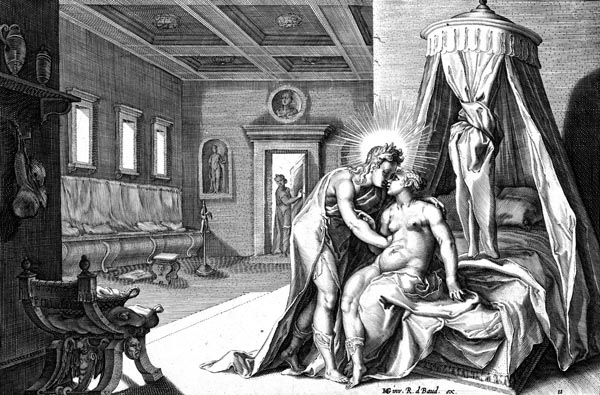
“Who measures the long year, I am he. I see all things, earth sees all things by me, I, the world’s eye. Trust me, you please me.” She is afraid, and, in her fear, distaff and spindle fall from her lifeless fingers. Her fear enhances her, and he, waiting no longer, resumes his true form, and his accustomed brightness. And, though the girl is alarmed by this sudden vision, overwhelmed by his brightness, suppressing all complaint, she submits to the assault of the god.’
Clytie was jealous (there were no bounds to her love for Sol), and goaded by anger at her rival, she broadcast the adultery, and maligning the girl, betrayed her to her father. He in his pride and savagery, buried her deep in the earth, she praying, stretching her hands out towards Sol’s light, crying “He forced me, against my will”, and he piled a heavy mound of sand over her.
Poor nymph, Hyperion’s son dispersed this with shafts of light, and gave you a way to show your buried face, but you could not lift your head, crushed by the weight of earth, and lay there, a pale corpse. They say the god of the winged horses had seen nothing more bitter than this, since Phaethon’s fiery death. He tried to see if he could recall life to those frozen limbs, with his powerful rays. But since fate opposed such efforts, he sprinkled the earth, and the body itself, with fragrant nectar, and, after much lamenting, said “You will still touch the air”. Immediately the body, soaked through with heavenly nectar, dissolved, steeping the earth in its perfume. Tentatively, putting out roots, the shoot of a tree, resinous with incense, grew through the soil, and pierced the summit of the mound.
Bk IV:256-273 Clytie is transformed into the heliotrope
The god of light no longer visited Clytie, nor found anything to love in her, even though love might have been an excuse for her pain, and her pain for her betrayal. She wasted away, deranged by her experience of love. Impatient of the nymphs, night and day, under the open sky, she sat dishevelled, bareheaded, on the bare earth. Without food or water, fasting, for nine days, she lived only on dew and tears, and did not stir from the ground. She only gazed at the god’s aspect as he passed, and turned her face towards him. They say that her limbs clung to the soil, and that her ghastly pallor changed part of her appearance to that of a bloodless plant: but part was reddened, and a flower like a violet hid her face. She turns, always, towards the sun, though her roots hold her fast, and, altered, loves unaltered.’
She finished speaking: the wonderful tale had charmed their ears. Part of them denies it could have happened, part says that the true gods can do anything. Though Bacchus is not one of those
https://www.poetryintranslation.com/PITBR/Latin/Metamorph4.php#highlightclytie
<<<<<<<<<<<<<<<<<<<<<<<<<<<<<<
back to alphabetical index
<<<<<<<<<<<<<<<<<<<<<<<<<<<<<<


 thingstothings