


our poems HERE …
@@@@@@@
Galileo knew his mythology. After discovering the four largest moons of Jupiter, he decided to name them, fittingly, after four famous loves of Zeus (Jupiter, to Romans): Io, Europa, Ganymede and Callisto. Of these four, Callisto’s story is the least well known, but maybe the most fascinating. Callisto (Kallisto in the Greek) was an Arcadian nymph, whose name literally means “most beautiful.” Her father was the infamous and cruel Lycaon, whom Jupiter changed into a wolf as punishment for his savage and “wolfish” behavior. He is often cited as a mythological precursor of the werewolf.
Lycaeon and Zeus
Zeus transforming Lycaeon to a wolf
Callisto preferred the woods to her father’s house. She loved to hunt and became a favorite of the goddess Artemis, joining her band of nymphs and swearing to remain a virgin eternally. Although today we might regard this as overly stringent, in the world of ancient mythology virginity meant freedom. As one of Artemis’ virgins, she would never have to marry a man of her father’s choosing, and could remain without domestic responsibilities in the woods her entire life.
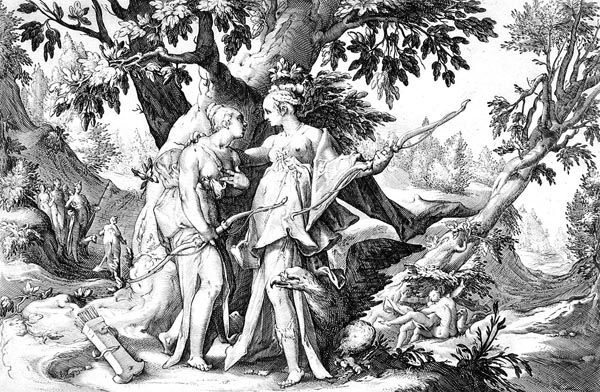
Unfortunately, like many beautiful nymphs, she caught the eye of Zeus. By this point in myth history Zeus was getting cannier in his disguises. Rather than transforming into a bull, or swan, Zeus decided to appear to the girl as Artemis herself. Ovid describes the two women talking intimately, then “Artemis” begins kissing Callisto.
It’s an electrifying moment, and an unusual one; there are very few surviving mentions of women loving women from the ancient world, simply because nearly all of the ancient writers were men. The references that do survive are generally dismissive or disgusted. But that is not that case here: Callisto welcomes her mistress’ passionate embrace. For a moment it almost seems like we have stumbled upon a wonderful secret history.
But the audience knows better, because it isn’t Artemis at all–it’s Zeus. The story gave its ancient readers just enough time to be intrigued, or titillated, or shocked before setting the world “right” again. Callisto’s error is played for laughs: she thinks it’s Artemis who she likes, but fake out! It’s really Zeus, who she doesn’t!
Zeus disguised as Artemis, with Callisto
Call me humorless, but I’m not laughing. Zeus reveals himself, rapes Callisto, then vanishes. The girl is doubly distraught—not only about the assault, but about the breaking of her oath of virginity to Artemis. (This being the ancient world, it doesn’t matter that it was unwilling—the oath is broken all the same). She is all the more distressed when she learns that she is pregnant, and must hide the pregnancy from her sharp-eyed mistress as long as possible.
We can see where this is going. Artemis is notoriously unsympathetic and uncompromising about transgressions—witness her punishment of poor Actaeon for accidentally glimpsing her in the bath: he’s torn apart by his own dogs. When Callisto takes off her dress to bathe, Artemis notices her belly. She flies into a rage, and is joined by Hera, who is herself angry at Callisto for having slept with her husband. As usual, Hera doesn’t care whether it was consensual. She turns the girl into a bear and Artemis kills her. Zeus (where were you five minutes ago?) swoops down to rescue Callisto’s unborn child, a boy named Arcas. And, in homage to the boy’s mother takes Callisto’s body and sets it in the sky as the “Great Bear”—Ursa Major. Her son, when he dies, joins her, becoming Ursa Minor.
Artemis discovers that Callisto is pregnant
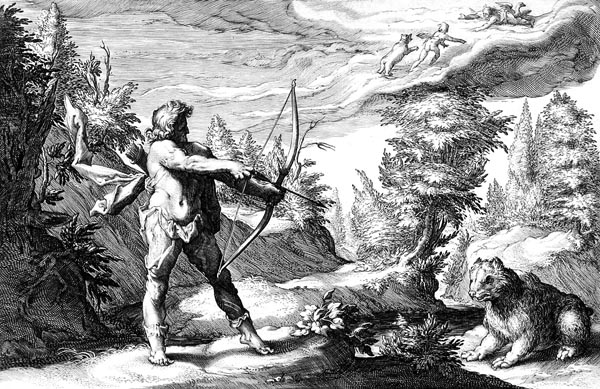
That’s one version of the story—in another, Callisto flees into the woods in her new ursine form, living out her days as an animal. Fast forward fifteen years or so. Callisto’s son, Arcas, has grown up a gifted hunter, just like his mother. He is wandering in the woods one day, and spots a bear. Hoisting his javelin, he prepares to kill it with a single blow. But as he is about to hurl the spear, Zeus stops him, not wanting him to be guilty of the sin of killing his own mother. He whisks the two of them up to the heavens, transforming them into constellations.
Ursa Major
Ursa Major, the Great Bear
In later generations, Zeus’ embrace of Callisto while disguised as Artemis was the part of the story that really seemed to grab people’s imaginations. Partially that’s because it was Ovid’s version, but surely also because of its frisson of transgression. But for me the most moving and tragic part of the story is the moment after, when Callisto realizes what is really happening. That she’s been tricked by Zeus, and is about to lose everything she holds dear—Artemis’ favor, her fidelity to her oath, her place in the world, even her humanity. Becoming a constellation just doesn’t seem like recompense enough.
A final, completely different, thought. Artemis seems to have been particularly associated with bears, and at her sanctuary at Brauron young girls would serve as “little bears” in a ritual to honor the goddess. It’s a much nicer face of the goddess than Callisto sees.
@@@@@@

Bk II:401-416 Jupiter sees Callisto
Now the all-powerful father of the gods circuits the vast walls of heaven and examines them to check if anything has been loosened by the violent fires. When he sees they are as solid and robust as ever he inspects the earth and the works of humankind. Arcadia above all is his greatest care. He restores her fountains and streams, that are still hardly daring to flow, gives grass to the bare earth, leaves to the trees, and makes the scorched forests grow green again.
Often, as he came and went, he would stop short at the sight of a girl from Nonacris, feeling the fire take in the very marrow of his bones. She was not one to spin soft wool or play with her hair. A clasp fastened her tunic, and a white ribbon held back her loose tresses. Dressed like this, with a spear or a bow in her hand, she was one of Diana’s companions. No nymph who roamed Maenalus was dearer to Trivia, goddess of the crossways, than she, Callisto, was. But no favour lasts long.
Bk II:417-440 Jupiter rapes Callisto
The sun was high, just path the zenith, when she entered a grove that had been untouched through the years. Here she took her quiver from her shoulder, unstrung her curved bow, and lay down on the grass, her head resting on her painted quiver. Jupiter, seeing her there weary and unprotected, said ‘Here, surely, my wife will not see my cunning, or if she does find out it is, oh it is, worth a quarrel!’ Quickly he took on the face and dress of Diana, and said ‘Oh, girl who follows me, where in my domains have you been hunting?’
The virgin girl got up from the turf replying ‘Greetings, goddess greater than Jupiter: I say it even though he himself hears it.’ He did hear, and laughed, happy to be judged greater than himself, and gave her kisses unrestrainedly, and not those that virgins give. When she started to say which woods she had hunted he embraced and prevented her and not without committing a crime. Face to face with him, as far as a woman could, (I wish you had seen her Juno: you would have been kinder to her) she fought him, but how could a girl win, and who is more powerful than Jove? Victorious, Jupiter made for the furthest reaches of the sky: while to Callisto the grove was odious and the wood seemed knowing. As she retraced her steps she almost forgot her quiver and its arrows, and the bow she had left hanging.
Bk II:441-465 Diana discover’s Callisto’s shame
Behold how Diana, with her band of huntresses, approaching from the heights of Maenalus, magnificent from the kill, spies her there, and seeing her calls out. At the shout she runs, afraid at first in case it is Jupiter disguised, but when she sees the other nymphs come forward she realises there is no trickery and joins their number. Alas! How hard it is not to show one’s guilt in one’s face! She can scarcely lift her eyes from the ground, not as she used to be, wedded to her goddess’s side or first of the whole company, but is silent and by her blushing shows signs of her shame at being attacked. Even if she were not herself virgin, Diana could sense her guilt in a thousand ways. They say all the nymphs could feel it.
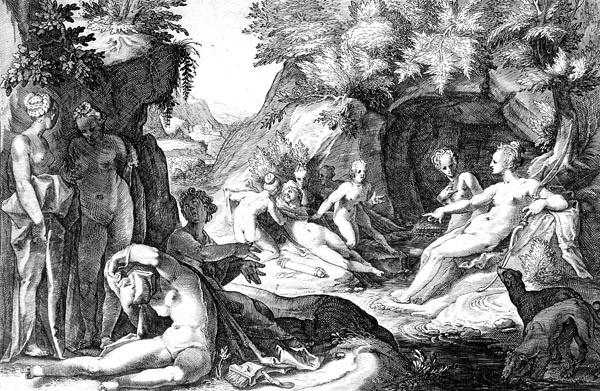
Nine crescent moons had since grown full when the goddess faint from the chase in her brother’s hot sunlight found a cool grove out of which a murmuring stream ran, winding over fine sand. She loved the place and tested the water with her foot. Pleased with this too she said ‘Any witness is far away, let’s bathe our bodies naked in the flowing water.’ The Arcadian girl blushed: all of them took off their clothes: one of them tried to delay: hesitantly the tunic was removed and there her shame was revealed with her naked body. Terrified she tried to conceal her swollen belly. Diana cried ‘Go, far away from here: do not pollute the sacred fountain!’ and the Moon-goddess commanded her to leave her band of followers.
Bk II:466-495 Callisto turned into a bear
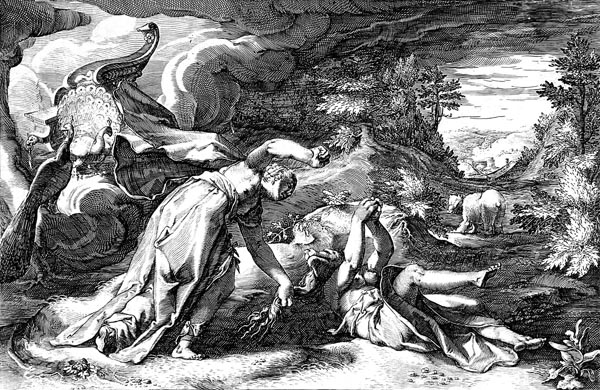
The great Thunderer’s wife had known about all this for a long time and had held back her severe punishment until the proper time. Now there was no reason to wait. The girl had given birth to a boy, Arcas, and that in itself enraged Juno. When she turned her angry eyes and mind to thought of him she cried out ‘Nothing more was needed, you adulteress, than your fertility, and your marking the insult to me by giving birth, making public my Jupiter’s crime. You’ll not carry this off safely. Now, insolent girl, I will take that shape away from you, that pleased you and my husband so much!’ At this she clutched her in front by the hair of her forehead and pulled her face forwards onto the ground. Callisto stretched out her arms for mercy: those arms began to bristle with coarse black hairs: her hands arched over and changed into curved claws to serve as feet: and her face, that Jupiter had once praised, was disfigured by gaping jaws: and so that her prayers and words of entreaty might not attract him her power of speech was taken from her. An angry, threatening growl, harsh and terrifying, came from her throat. Still her former feelings remained intact though she was now a bear. She showed her misery in continual groaning, raising such hands as she had left to the starry sky, feeling, though she could not speak it, Jupiter’s indifference. Ah, how often she wandered near the house and fields that had once been her home, not daring to sleep in the lonely woods! Ah, how often she was driven among the rocks by the baying hounds, and the huntress fled in fear from the hunters! Often she hid at the sight of wild beasts forgetting what she was, and though a bear she shuddered at the sight of other bears on the mountains and feared the wolves though her father Lycaon ran with them.
Bk II:496-507 Arcas and Callisto become constellations
And now Arcas, grandson of Lycaon, had reached his fifteenth year ignorant of his parentage. While he was hunting wild animals, while he was finding suitable glades and penning up the Erymanthian groves with woven nets, he came across his mother, who stood still at sight of Arcas and appeared to know him. He shrank back from those unmoving eyes gazing at him so fixedly, uncertain what made him afraid, and when she quickly came nearer he was about to pierce her chest with his lethal spear. All-powerful Jupiter restrained him and in the same moment removed them and the possibility of that wrong, and together, caught up through the void on the winds, he set them in the heavens and made them similar constellations, the Great and Little Bear.
Bk II:508-530 Juno complains to Tethys and Oceanus
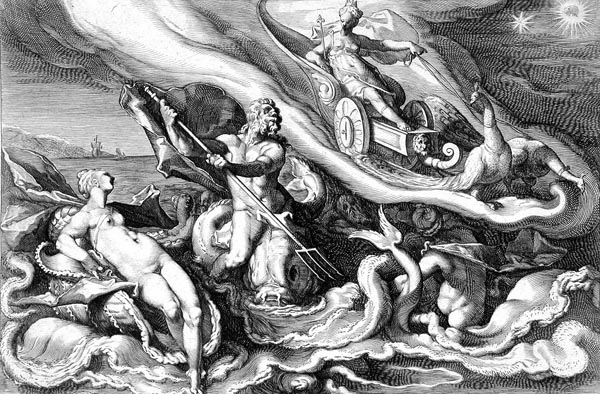
Juno was angered when she saw his inamorato shining among the stars, and went down into the waters to white-haired Tethys and old Oceanus to whom the gods often make reverence. When they asked her the reason for her visit she began ‘You ask me why I, the queen of the gods, have left my home in the heavens to be here? Another has taken my place in the sky! I tell a lie, if you do not see, when night falls and the world darkens, newly exalted stars to wound me, set in the sky, where the remotest and shortest orbit circles the uttermost pole. Why should anyone wish to avoid wounding Juno or dread my enmity if I only benefit those I harm? Oh what a great achievement! Oh what marvellous powers I have! I stopped her being human and she becomes a goddess! This is the punishment I inflict on the guilty! This is my wonderful sovereignty! Let him take away her animal form and restore her former beauty as he did before with that Argive girl, Io. Why not divorce Juno, install her in my place, and let Lycaon be his father-in-law? If this contemptible insult to your foster-child moves you, shut out the seven stars of the Bear from your dark blue waters, repulse this constellation set in the heavens as a reward for her defilement, and do not let my rival dip in your pure flood!’
https://www.poetryintranslation.com/PITBR/Latin/Metamorph2.php#Bktwo401
<<<<<<<<<<<<<<<<<<<<<<<<<<<<<<
<<<<<<<<<<<<<<<<<<<<<<<<<<<<<<
 thingstothings