

poems …
The Golden Age – Arthur Rimbaud
our poems HERE …

@@@@@@@
the story in short –
The Golden Age
The Golden Age under the rule of Saturn was a time of happiness and plenty. The Earth was bountiful and it was a time of happily communal living without laws or any need of laws. There was no travel.
The Silver Age
The Silver Age began as Jupiter overthrew his father (who, to be fair, HAD been eating his children) and Saturn was consigned to Tartaros.
Jupiter as part of his Improvement Plan shortened the Eternal Spring to become only one of four seasons. Icicles began to appear in winter and so houses became necessary and folk who had previously lain around eating strawberries began to have to work. They ploughed the earth and learned agriculture and bullocks strained under their yokes
The Bronze Age
In the bronze age the peaceful people of the golden age became fierce and inclined to savage warfare but not, Ovid says, as yet vicious.
Worse is to come in …
The Iron Age
Which is when men first became truly horrible. ‘Immediately every kind of wickedness erupted into this age of baser natures: truth, shame and honour vanished; in their place were fraud, deceit, and trickery, violence and pernicious desires.’
They built ships and took to the sea, claiming territory and the land which had once been as free to everyone as is the sun and the air, now became property. They demanded tribute and also dug deep in the earth for metals ‘And now harmful iron appeared, and gold more harmful than iron’
‘War came, whose struggles employ both, waving clashing arms with bloodstained hands. They lived on plunder: friend was not safe with friend, relative with relative, kindness was rare between brothers. Husbands longed for the death of their wives, wives for the death of their husbands. Murderous stepmothers mixed deadly aconite, and sons inquired into their father’s years before their time.‘
This is when Astraea, the finally gave up all hope and left the earth to become the Celestial Virgin in the stars ‘Piety was dead, and virgin Astraea, last of all the immortals to depart, herself abandoned the blood-drenched earth’

Note:- It is very obvious that the Greeks (and Romans too? Certainly Ovid) saw the progression of the Ages, and indeed what we would regard as technical improvements, as not just a Decline but something more like a road to Hell in a Handcart.

An interesting observation that Gold has been even more harmful than Iron as being the motivator of crime and of wars.


re:- Astraea. The Return of Astraea bringing with her a return of kindness and justice was one of the aims of the Renaissance
see Frances Yates 'Astraea'
Third came the people of the bronze age, with fiercer natures, readier to indulge in savage warfare, but not yet vicious. The harsh iron age was last. Immediately every kind of wickedness erupted into this age of baser natures: truth, shame and honour vanished; in their place were fraud, deceit, and trickery, violence and pernicious desires. They set sails to the wind, though as yet the seamen had poor knowledge of their use, and the ships’ keels that once were trees standing amongst high mountains, now leaped through uncharted waves. The land that was once common to all, as the light of the sun is, and the air, was marked out, to its furthest boundaries, by wary surveyors. Not only did they demand the crops and the food the rich soil owed them, but they entered the bowels of the earth, and excavating brought up the wealth it had concealed in Stygian shade, wealth that incites men to crime. And now harmful iron appeared, and gold more harmful than iron. War came, whose struggles employ both, waving clashing arms with bloodstained hands. They lived on plunder: friend was not safe with friend, relative with relative, kindness was rare between brothers. Husbands longed for the death of their wives, wives for the death of their husbands. Murderous stepmothers mixed deadly aconite, and sons inquired into their father’s years before their time. Piety was dead, and virgin Astraea, last of all the immortals to depart, herself abandoned the blood-drenched earth
see Frances Yates ‘Astraea’
…

 NEXT-
NEXT- @@@@@@@
Bk I:89-112 The Golden Age
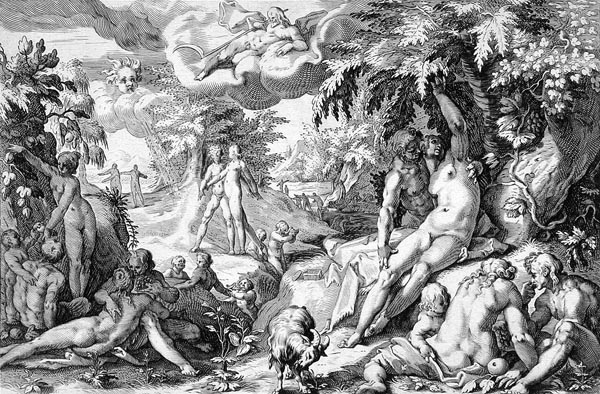
This was the Golden Age that, without coercion, without laws, spontaneously nurtured the good and the true. There was no fear or punishment: there were no threatening words to be read, fixed in bronze, no crowd of suppliants fearing the judge’s face: they lived safely without protection. No pine tree felled in the mountains had yet reached the flowing waves to travel to other lands: human beings only knew their own shores. There were no steep ditches surrounding towns, no straight war-trumpets, no coiled horns, no swords and helmets. Without the use of armies, people passed their lives in gentle peace and security. The earth herself also, freely, without the scars of ploughs, untouched by hoes, produced everything from herself. Contented with food that grew without cultivation, they collected mountain strawberries and the fruit of the strawberry tree, wild cherries, blackberries clinging to the tough brambles, and acorns fallen from Jupiter’s spreading oak-tree. Spring was eternal, and gentle breezes caressed with warm air the flowers that grew without being seeded. Then the untilled earth gave of its produce and, without needing renewal, the fields whitened with heavy ears of corn. Sometimes rivers of milk flowed, sometimes streams of nectar, and golden honey trickled from the green holm oak.
Bk I:113-124 The Silver Age
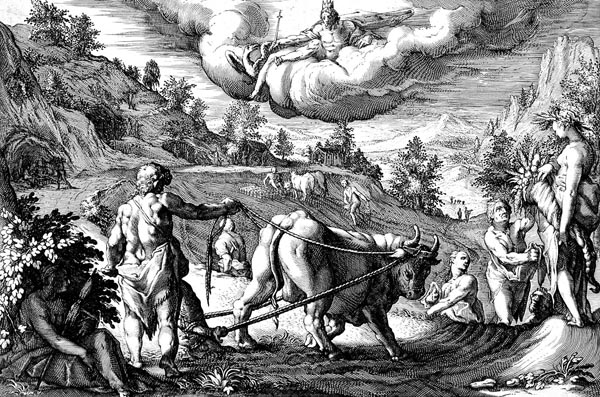
When Saturn was banished to gloomy Tartarus, and Jupiter ruled the world, then came the people of the age of silver that is inferior to gold, more valuable than yellow bronze. Jupiter shortened spring’s first duration and made the year consist of four seasons, winter, summer, changeable autumn, and brief spring. Then parched air first glowed white scorched with the heat, and ice hung down frozen by the wind. Then houses were first made for shelter: before that homes had been made in caves, and dense thickets, or under branches fastened with bark. Then seeds of corn were first buried in the long furrows, and bullocks groaned, burdened under the yoke.
Bk I:125-150 The Bronze and Iron Ages
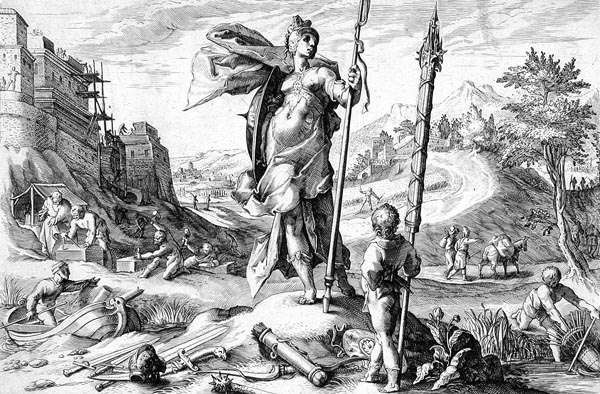
Third came the people of the bronze age, with fiercer natures, readier to indulge in savage warfare, but not yet vicious. The harsh iron age was last. Immediately every kind of wickedness erupted into this age of baser natures: truth, shame and honour vanished; in their place were fraud, deceit, and trickery, violence and pernicious desires. They set sails to the wind, though as yet the seamen had poor knowledge of their use, and the ships’ keels that once were trees standing amongst high mountains, now leaped through uncharted waves. The land that was once common to all, as the light of the sun is, and the air, was marked out, to its furthest boundaries, by wary surveyors. Not only did they demand the crops and the food the rich soil owed them, but they entered the bowels of the earth, and excavating brought up the wealth it had concealed in Stygian shade, wealth that incites men to crime. And now harmful iron appeared, and gold more harmful than iron. War came, whose struggles employ both, waving clashing arms with bloodstained hands. They lived on plunder: friend was not safe with friend, relative with relative, kindness was rare between brothers. Husbands longed for the death of their wives, wives for the death of their husbands. Murderous stepmothers mixed deadly aconite, and sons inquired into their father’s years before their time. Piety was dead, and virgin Astraea, last of all the immortals to depart, herself abandoned the blood-drenched earth.
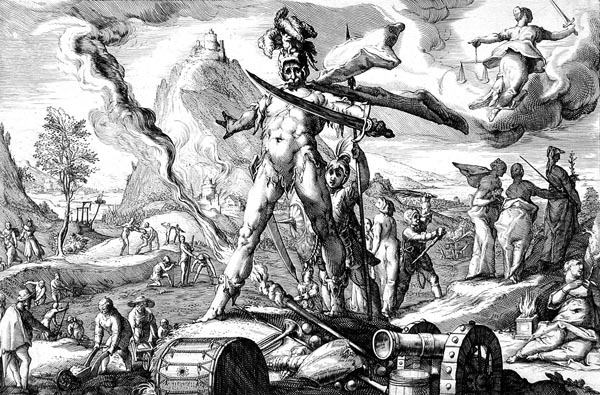
Bk I:151-176 The giants
Rendering the heights of heaven no safer than the earth, they say the giants attempted to take the Celestial kingdom, piling mountains up to the distant stars. Then the all-powerful father of the gods hurled his bolt of lightning, fractured Olympus and threw Mount Pelion down from Ossa below. Her sons’ dreadful bodies, buried by that mass, drenched Earth with streams of blood, and they say she warmed it to new life, so that a trace of her children might remain, transforming it into the shape of human beings. But these progeny also despising the gods were savage, violent, and eager for slaughter, so that you might know they were born from blood.
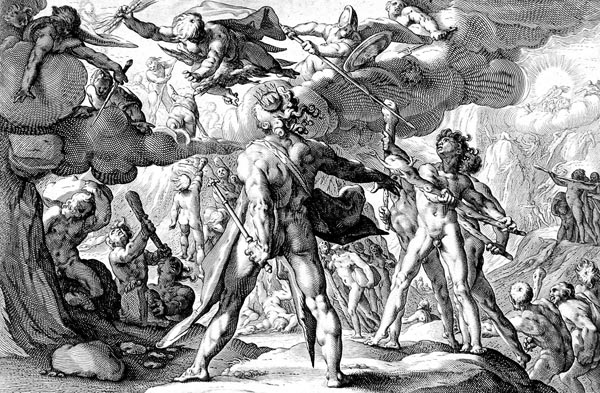
When Saturn’s son, the father of the gods, saw this from his highest citadel, he groaned, and recalling the vile feast at Lycaon’s table, so recent it was still unknown, his mind filled with a great anger fitting for Jupiter, and he called the gods to council, a summons that brooked no delay.
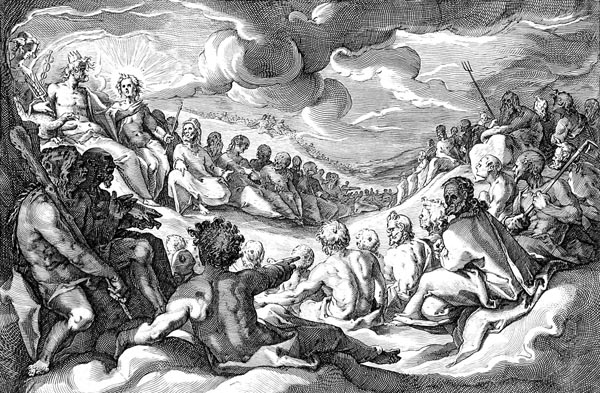
There is a high track, seen when the sky is clear, called the Milky Way, and known for its brightness. This way the gods pass to the palaces and halls of the mighty Thunderer. To right and left are the houses of the greater gods, doors open and crowded. The lesser gods live elsewhere. Here the powerful and distinguished have made their home. This is the place, if I were to be bold, I would not be afraid to call high heaven’s Palatine.
Bk I:177-198 Jupiter threatens to destroy humankind
When the gods had taken their seats in the marble council chamber their king, sitting high above them, leaning on his ivory sceptre, shook his formidable mane three times and then a fourth, disturbing the earth, sea and stars. Then he opened his lips in indignation and spoke. ‘I was not more troubled than I am now concerning the world’s sovereignty than when each of the snake-footed giants prepared to throw his hundred arms around the imprisoned sky. Though they were fierce enemies, still their attack came in one body and from one source. Now I must destroy the human race, wherever Nereus sounds, throughout the world. I swear it by the infernal streams, that glide below the earth through the Stygian groves. All means should first be tried, but the incurable flesh must be excised by the knife, so that the healthy part is not infected. Mine are the demigods, the wild spirits, nymphs, fauns and satyrs, and sylvan deities of the hills. Since we have not yet thought them worth a place in heaven let us at least allow them to live in safety in the lands we have given them. Perhaps you gods believe they will be safe, even when Lycaon, known for his savagery, plays tricks against me, who holds the thunderbolt, and reigns over you.’
Bk I:199-243 Lycaon is turned into a wolf
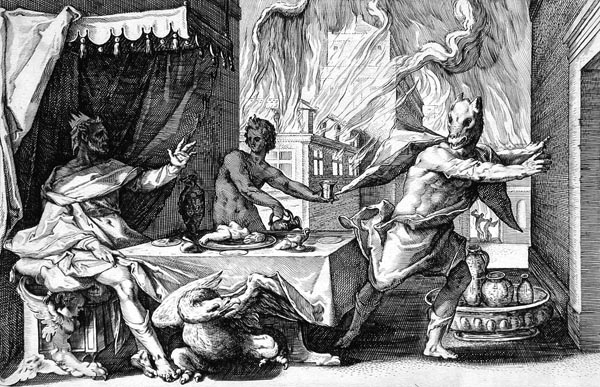
All the gods murmured aloud and, zealously and eagerly, demanded punishment of the man who committed such actions. When the impious band of conspirators were burning to drown the name of Rome in Caesar’s blood, the human race was suddenly terrified by fear of just such a disaster, and the whole world shuddered with horror. Your subjects’ loyalty is no less pleasing to you, Augustus, than theirs was to Jupiter. After he had checked their murmuring with voice and gesture, they were all silent. When the noise had subsided, quieted by his royal authority, Jupiter again broke the silence with these words: ‘Have no fear, he has indeed been punished, but I will tell you his crime, and what the penalty was. News of these evil times had reached my ears. Hoping it false I left Olympus’s heights, and travelled the earth, a god in human form. It would take too long to tell what wickedness I found everywhere. Those rumours were even milder than the truth. I had crossed Maenala, those mountains bristling with wild beasts’ lairs, Cyllene, and the pinewoods of chill Lycaeus. Then, as the last shadows gave way to night, I entered the inhospitable house of the Arcadian king. I gave them signs that a god had come, and the people began to worship me. At first Lycaon ridiculed their piety, then exclaimed ‘I will prove by a straightforward test whether he is a god or a mortal. The truth will not be in doubt.’ He planned to destroy me in the depths of sleep, unexpectedly, by night. That is how he resolved to prove the truth. Not satisfied with this he took a hostage sent by the Molossi, opened his throat with a knife, and made some of the still warm limbs tender in seething water, roasting others in the fire. No sooner were these placed on the table than I brought the roof down on the household gods, with my avenging flames, those gods worthy of such a master. He himself ran in terror, and reaching the silent fields howled aloud, frustrated of speech. Foaming at the mouth, and greedy as ever for killing, he turned against the sheep, still delighting in blood. His clothes became bristling hair, his arms became legs. He was a wolf, but kept some vestige of his former shape. There were the same grey hairs, the same violent face, the same glittering eyes, the same savage image. One house has fallen, but others deserve to also. Wherever the earth extends the avenging furies rule. You would think men were sworn to crime! Let them all pay the penalty they deserve, and quickly. That is my intent.’
https://www.poetryintranslation.com/PITBR/Latin/Metamorph.php#anchor_Toc64105451
<<<<<<<<<<<<<<<<<<<<<<<<<<<<<<
<<<<<<<<<<<<<<<<<<<<<<<<<<<<<<
 thingstothings